Showing posts with label addition. Show all posts

Sunday, April 9, 2017

Time to Review Skills for State Testing!

For many of us, state testing for math has not taken place yet, but it's right around the corner!
You know what that means?! Yup! Teachers are lighting candles and saying prayers all over the states! Also, sales for stress balls are skyrocketing! Not to mention wine sales are hitting the roof!

Okay! Okay. All mentioned above might not be true for everyone, but hey...ya' never know!  😉

Truth is, we are spending time reviewing with our students to make sure they remember the skills and strategies we have taught them throughout the year. Positive attitudes along with stress levels are high! (Sorry. My humor keeps getting in the way of my post.)😁

If you are getting stressed. Be sure to smile or laugh. As a matter of fact, be sure to do it every day and every chance you get! Laughter is a great stress reliever. Don't let the small stuff get to you. Ya' haven't died from state testing or state scores yet, and you aren't going to! I promise. :D  Just don't smile to hard, otherwise you're just going to look constipated. That's never a good look for anyone. (Oops! There's that humor again! Sorry!)😄

With that said, I just wanted to share time savers that I have for testing practice available at my teachers pay teachers store. They are quick and easy to prep and don't cost very much. I promise!

Small group instruction and math stations are a great way to review! Check these activities out. You might find something that will save you time and take a load of stress off your back at the same time.
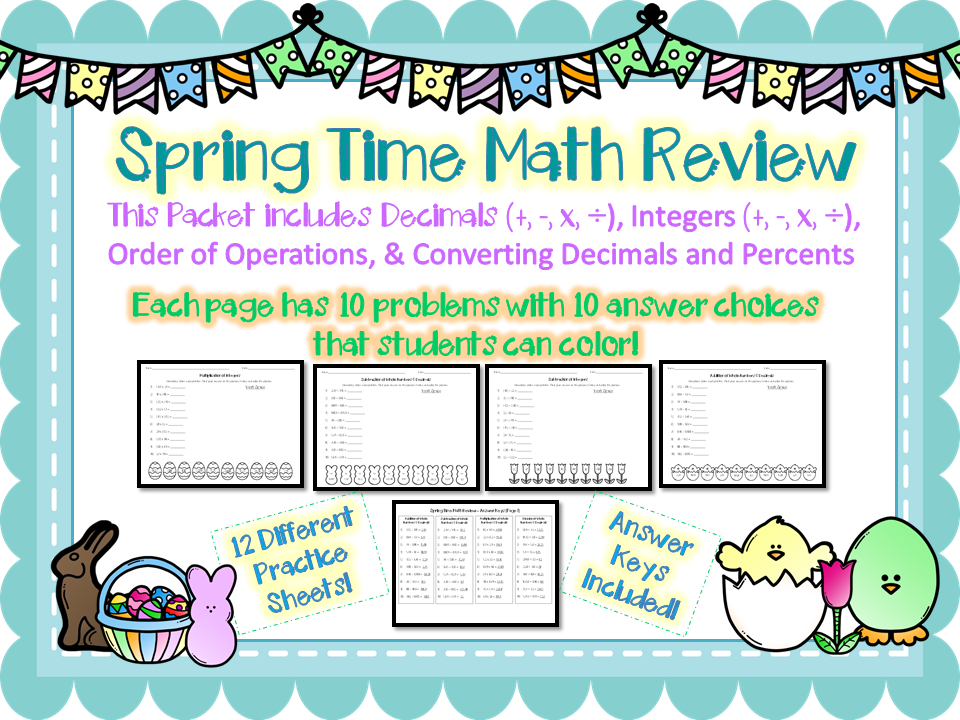

Spring Time Math Review - This set has a great mix of computation review. It contains twelve different practice sheets and included answer keys. Students solve problems in space provided, then look for their answer found on the characters at the bottom of the page. They can shade in or color the characters.


Fraction, Decimal, Percents Puzzles - These are really quick and easy to prep. Just print and cut apart using straight cuts. No curves to go around. That takes FOREVER!!! Sorry, just a little venting. Anyway! Students match the equivalent fraction, decimal and percent to create a rectangle for the set.


Area of Composite Figures and Shaded Regions Loop Game - Loop Games get your students walking and talking about math! It's great to use for cooperative learning as well. Just print out cards, shuffle them up and tape them around the walls in your classroom. Then group students and have each group start at different cards. Students solve the problem on the card then look for the answer on another card in the room. Once they find it, they then go to that problem and solve it. This continues until students solve all problems and end up back on the first card they started on. A fun way to review and also gets students teaching other students if they forgot about a skill.


Fact or Fib Attributes of 3 Dimensional Figures - Fact or Fib is a great activity that will get the entire class involved. I have Fact or Fibs on PowerPoint so you can move on to the next slide when the class is ready. I have animated the slides which allows for more student engagement.  They are easy to use! Just show a slide, give students time to think whether the statement shown is a fact or fib, then countdown from three to have them all show their Fact or Fib cards at once. Click on to the next slide to see the answer. Students can then discuss why they chose they answer they did and if it was correct. Then move on to the next slide.  You can get a free download of my Fact or Fib cards HERE.


Polygon Smack Down - Don't worry!!! Students don't smack each other with this one! It is a competitive activity though! Divide class into two teams, show mini poster on the board or wall via projector, read a clue card, then countdown from three to let students know when they can go up and "smack down" their hand or fly swatter on their answer. Whoever does it first gets a point for their team! Lots of fun in the classroom with this one. I have a few to select from.
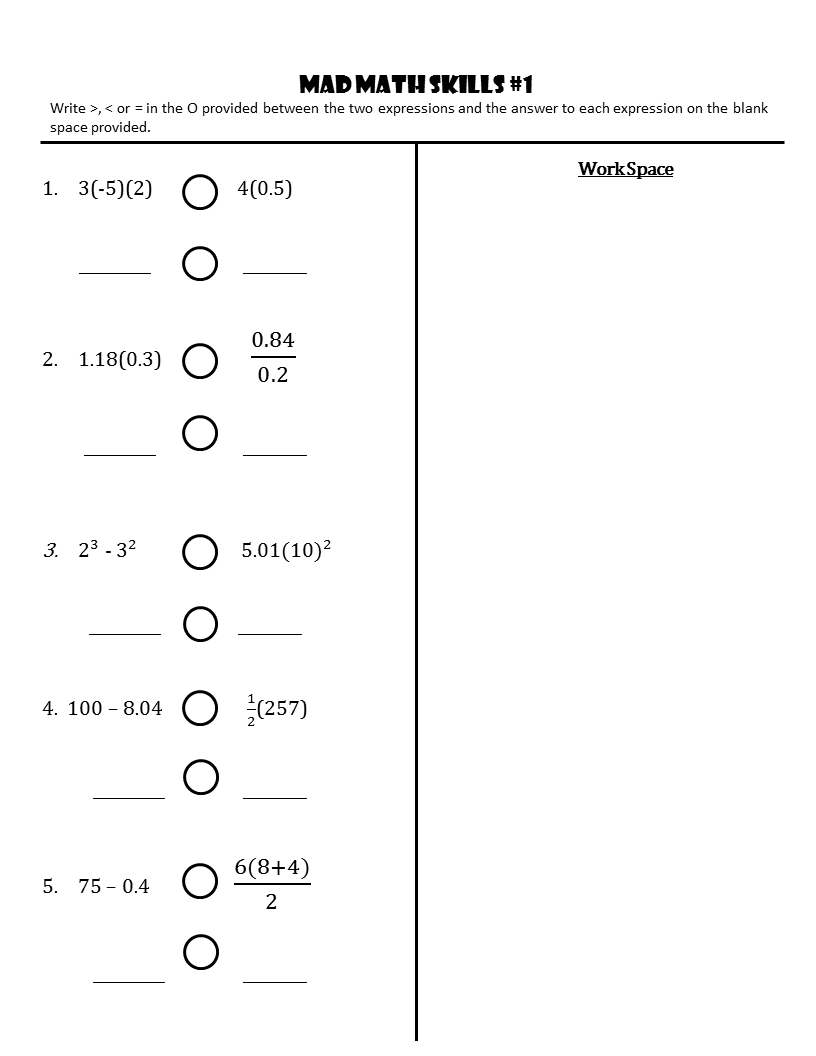
Mad Math Skills - This has five different practice sheets! A great way to review many skills at once. Answer keys are included for easy grading.  Each problem contains two expressions that students solve, then they compare the answers using inequality symbols. Can be used as class work, home work or even a warm up!


Gridded Response Boards for State Testing Practice - These are quick and easy to make and can be used year round! Just print, laminate or insert into page protector. Students can then use a dry erase marker to solve problems and show their response on one side and practice gridding their answers on the other side. Easy clean up too! If you didn't see one that you can use in your classroom, contact me! Maybe I can create it.

Well, there you have it! Just a few of the activities that I have created and have available at my Teachers Pay Teachers store. There are plenty more to choose from! So if you didn't find a skill you needed here but liked the activity, be sure to check out my store. I just might have the skill you are looking for with the activity you wanted. 

If there is something in particular that you would like to see, be sure to contact me! I just might be able to create it.

Thanks so much for looking and have a wonderful day and good luck to everyone on all state tests. Just like everything else, this too shall pass and so will our kiddos!!!  😉


Sunday, January 22, 2017

Line them up!

I teach six 45 minute 7th grade math classes and one 45 minute math enrichment class. The math enrichment class rotates with three other core subject area teachers in my pod throughout the week. During enrichment, I try to focus on students' math weaknesses and create or look for activities to strengthen them. With that said, there is one weakness that was really driving me nuts! So this is what I did.

Many of my students were making careless mistakes when adding or subtracting whole numbers and decimals. They know about place value. They know how to set up a whole number as a decimal. However, I think they get "caught up in the moment" when solving a problem and just rush through it.  I don't know if you are aware of this, but, some students just don't like math and their goal is usually to hurry up and finish their work so that they can do something else. (Insert sarcasm here.)

I've tried several strategies, such as having them write whole numbers as money. Everyone likes money, right?! Well, that only helped a few. Then I tried having them underline the ones place in the numbers and to line those up. That was a flop. Apparently, it's too much work to underline numbers. When I would point it out to students, their response was, "Oh! I forgot." Now, when I say "point it out", all I had to say was, "This is set up incorrectly." and almost immediately they remembered the proper way.  So this is why I say that they are just rushing and they really do know how to do this. Don't you hate that this sort of stuff happens a lot in math class?

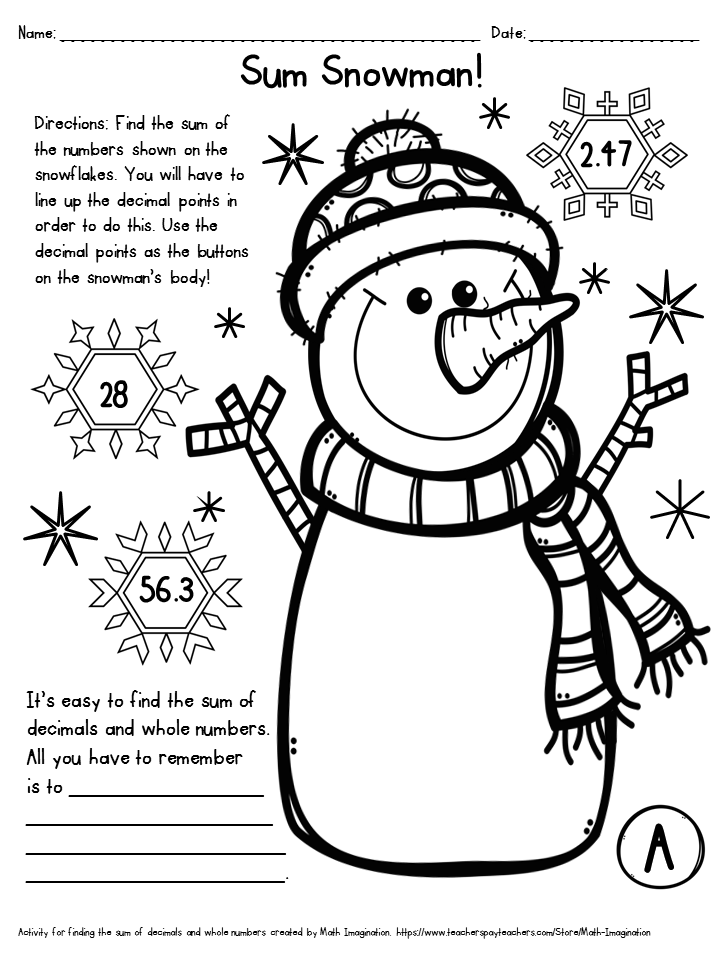
When I taught fifth grade back in the day, I remember a snowman activity I created that would help students focus on the correct way to set up problems when adding whole numbers with decimals. I gave students a picture of a snowman and a problem. They were to add three numbers, two decimal numbers and one whole number. They were to set up the numbers on the body of the snowman so that the decimal points were the buttons on the snowman. It was only one problem, but my goal with this activity was about quality, not quantity. It really helped that time, so why not try it out with my 7th graders during enrichment?

This is the activity as I created it for my 7th graders.


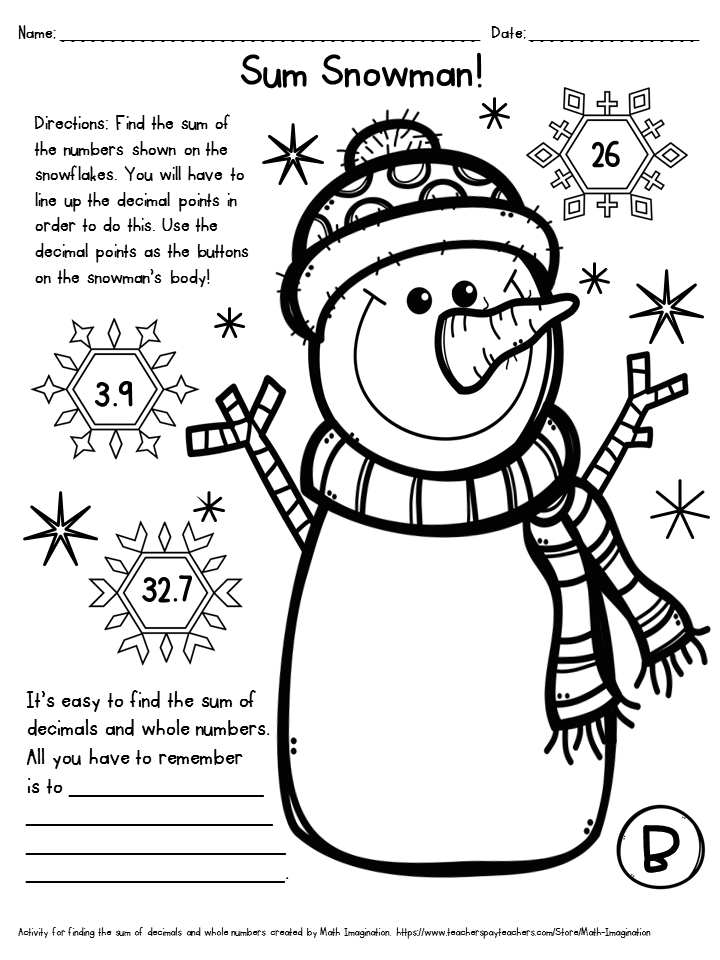
I made 26 different problems involving addition of two decimal numbers and a whole number. Students were each given a problem but asked to work in groups so that they could discuss and help each other when solving. 


Everyone has a different problem, so no cheating could take place. I asked them to solve their problem on the back of their page first so if they had to erase, it was okay. Notice the snowball at the lower right hand corner? That's their problem's letter. After they solve their problem, they were to go to the board to check their answer. They just had to look for their problem's letter to do that.


I also displayed a picture of the snowman with a problem completed to show students how the "buttons" should look.  If they answered correctly, they were to complete the front of the page and color the snowman. If they were incorrect, they were to go back and correct it.


Students did enjoy the activity and there were many great discussions.  With this activity, I know a great memory was made that will help them remember to line up those decimals! Their discussions also helped them to complete the statement at the bottom of the page. It also makes a great display. It's a win-win!!!

You can find this activity HERE.

I hope you find this activity helpful. It can be used for different grade levels, as a ticket out the door or as I review.  

Thanks for reading and have a wonderful day!!!!


Tuesday, July 12, 2016

Change it up a little with this dice game!

At the beginning of each school year, I find it helps students to do activities that will review skills that I know they didn't practice during the summer. 

This is an easy activity to prep and use to review computation of three digit numbers, as well as place value.


All you need are 7 number cubes (a.k.a. dice), label stickers and a marker.  Actually, you can use as many number cubes as you wish. 
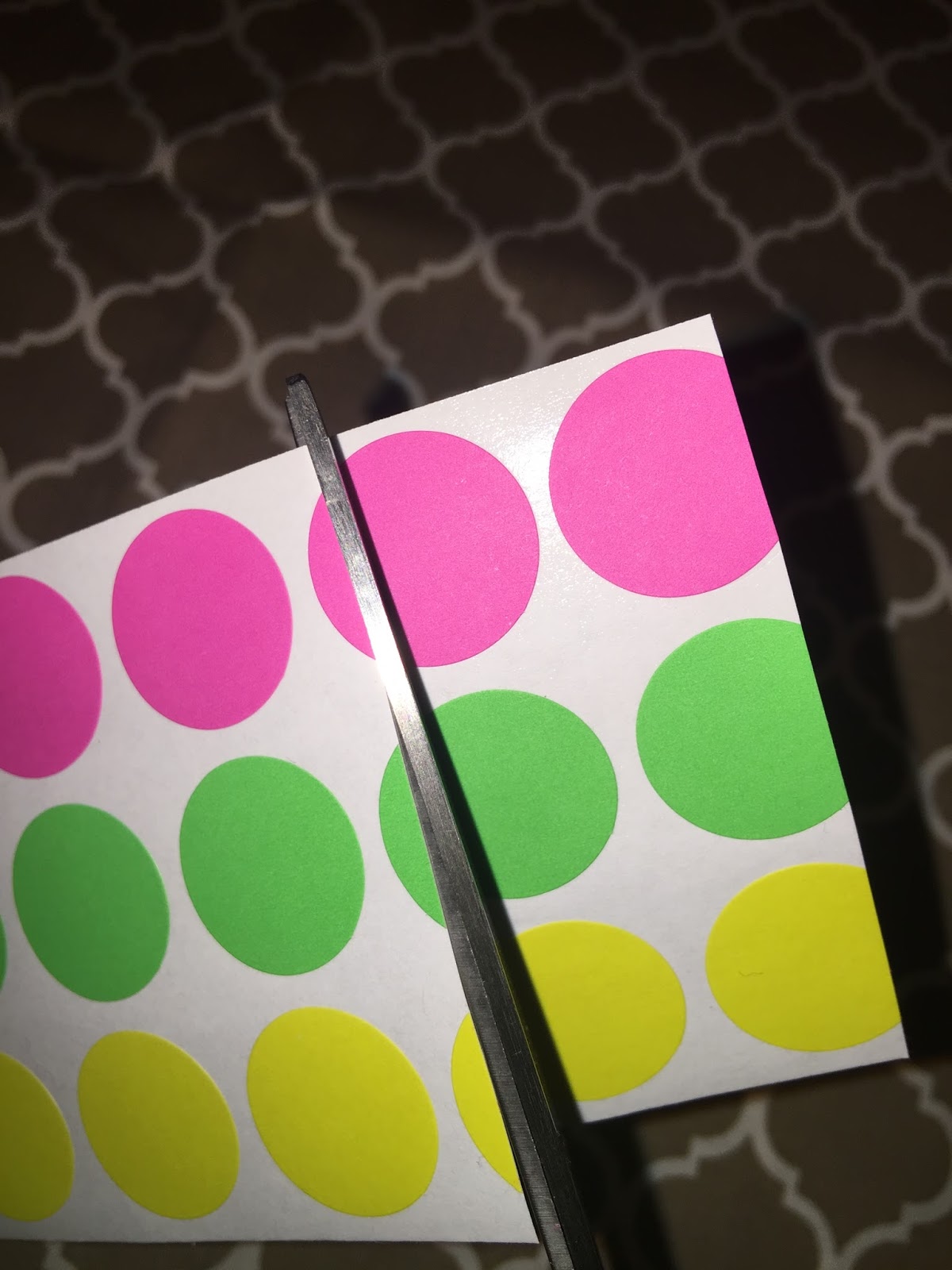
I only had these circle stickers available, but they were larger than the sides of the cubes, so all I did was cut them into the squares. 


You will only need six stickers per cube.


For this set, I only used addition and multiplication.  But you can change it up depending on the grade level.  Just keep in mind that if you use subtraction, some answers will be negative.  If you use division, instruct students to create a fraction/mixed number or decimal as the answer.  Rounding might be necessary for the latter.

I placed a multiplication sign and addition sign opposite to each other.  In other words, "X" on top and "+" on bottom.


This is what they ended up looking like when I was done.  The stickers held on pretty good, so I'm not really worried about them popping off. If they do, I'll probably just cover with clear tape.


So, here are the directions to the game.  Again, depending on grade level, you can make this anywhere from a 2-digit by 1-digit game to a 4-digit by 2-digit game.  It just depends on students and what they need to practice.

This is a two to four player game. There are three sets to roll per round.  The first roll creates the first number in the problem. The second roll determines the operation (x or +). The third roll determines the second number in the problem.


In this pic, you can see the first roll came up with a 1, 5 and 3.  The second roll came up as "x", and the third roll came up with a 6, 4, and 4.

Here is where the place value comes in. Have students discuss the largest possible number they can create with what they rolled.  In this case, the first number is 532 and the second is 644.  Now students just multiply the two together.

This can become a self checking activity simply by assigning a calculator and having each player take turns checking the answer to see who did it correctly.  This provides immediate feedback for students that might have erred in their calculations.

I hope this was helpful! If you have any other ideas to add using this activity, please leave them in the comments below.

Thanks for looking!!!

Wednesday, June 22, 2016

Practice Integers with a Deck of Cards!

First of all, I know first hand that buying materials for your classroom can get pricey and adds up to quite a bit by the end of the year.  This is why I try to look for ways to save money on items for my classroom.  I also try to look for items I can use in more than one way.

Now, onward to using a deck of cards for integers!

I found the best deal at Dollar Tree!  You get TWO decks of cards for $1!  Fifty cents a deck is a real bargain. Of course, if you can get them donated, that would be even better.


Here is what the package looks like if you happen to have a Dollar Tree near you.  If not, I'm sure you can find them at other types of dollar stores.


They are glossy and pretty durable.
I usually take out the Jokers, since I have no use for them.


This is how I use a deck of cards to have my students practice addition of integers.  My students call it Integer War and it is a game for two players.

First, I tell students that all face cards (King, Queen, Jack) have a value of 10.  All blacks are positive and all reds are negative.

For example, 6 of diamonds (red) has a value of (-6) and a Jack of spades (black) has a value of (+10).  I then instruct students to use addition to solve.

Step 1: Divide the entire deck of cards between two players.


Step 2: Both players take a card from the very top of their stack and place them down next to each other.  Be sure to tell you students that peeking is not allowed!  They MUST take the card from the top of the stack.  Now they have created an integer problem!  This one shows (+10) + (-8).
Step 3: The first student to shout out the answer takes both cards.  The coolest part is that they can use the symbols on the cards to create their "zero pairs" if they are still struggling solving it mentally!  Since face cards don't have symbols, you can have students take all face cards out for the first few times they play this game.  Then have them play the game with the face cards included as they are gradually building integer fluency.

Here are some more examples:

(+10) + (+7) = (+17)

(+10) + (-10) = 0


(-4) + (+10) = (+6)
(-10) + (+8) = (-2)
(-10) + (-10) = (-20)

It's that easy!

I think the colors really help students determine positive and negative values and understand when they have to add or subtract the values.


I usually have my students seated in groups of four. So what I do is have two students play against each other and the other two students use a calculator to check the answer.  That way they know who stated the correct answer first.  Then the pairs of students trade tasks.  It's a great way to build integer fluency and students end up discussing when answers are incorrect.  They teach each other!  How awesome it that?!

Take it to the next level!  After students understand directions and the goal of this game, change it up and have them subtract the integers.  I usually have them write down the problem when they use subtraction.  Eventually, I also have them practice multiplication of integers.

So you actually get THREE activities that will have your students practicing with integers using only one deck of cards!


WARNING!  When students are playing this game, you will hear them gradually get louder as they shout out the answer, because they want to win!  They get really excited.  Student engagement at it's finest!  :D

Here are some of the activities I have available at my Teachers Pay Teachers Store.

Integer Fluency Circles


Exponents with Integers


Christmas Tree Negatives and Positives - Mixed Computation with Integers This one is FREE!


I will be posting other ways I use decks of cards in my classroom at a later date.  Stay tuned!

Thanks for looking.  I hope this was helpful!