Showing posts with label decimals. Show all posts

Sunday, January 22, 2017

Line them up!

I teach six 45 minute 7th grade math classes and one 45 minute math enrichment class. The math enrichment class rotates with three other core subject area teachers in my pod throughout the week. During enrichment, I try to focus on students' math weaknesses and create or look for activities to strengthen them. With that said, there is one weakness that was really driving me nuts! So this is what I did.

Many of my students were making careless mistakes when adding or subtracting whole numbers and decimals. They know about place value. They know how to set up a whole number as a decimal. However, I think they get "caught up in the moment" when solving a problem and just rush through it.  I don't know if you are aware of this, but, some students just don't like math and their goal is usually to hurry up and finish their work so that they can do something else. (Insert sarcasm here.)

I've tried several strategies, such as having them write whole numbers as money. Everyone likes money, right?! Well, that only helped a few. Then I tried having them underline the ones place in the numbers and to line those up. That was a flop. Apparently, it's too much work to underline numbers. When I would point it out to students, their response was, "Oh! I forgot." Now, when I say "point it out", all I had to say was, "This is set up incorrectly." and almost immediately they remembered the proper way.  So this is why I say that they are just rushing and they really do know how to do this. Don't you hate that this sort of stuff happens a lot in math class?

When I taught fifth grade back in the day, I remember a snowman activity I created that would help students focus on the correct way to set up problems when adding whole numbers with decimals. I gave students a picture of a snowman and a problem. They were to add three numbers, two decimal numbers and one whole number. They were to set up the numbers on the body of the snowman so that the decimal points were the buttons on the snowman. It was only one problem, but my goal with this activity was about quality, not quantity. It really helped that time, so why not try it out with my 7th graders during enrichment?

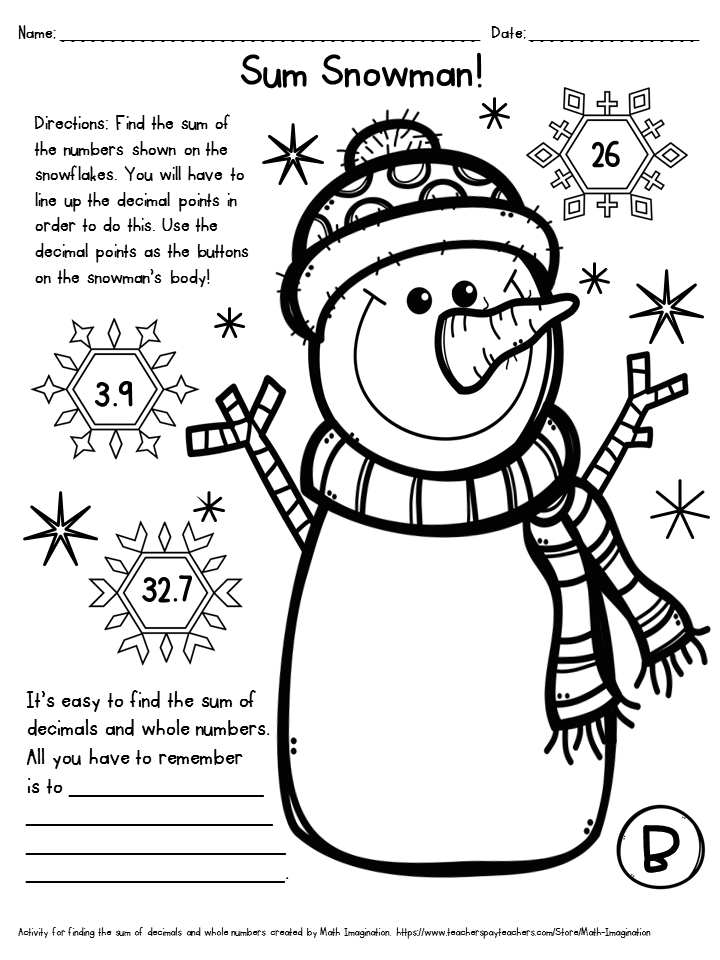
This is the activity as I created it for my 7th graders.


I made 26 different problems involving addition of two decimal numbers and a whole number. Students were each given a problem but asked to work in groups so that they could discuss and help each other when solving. 
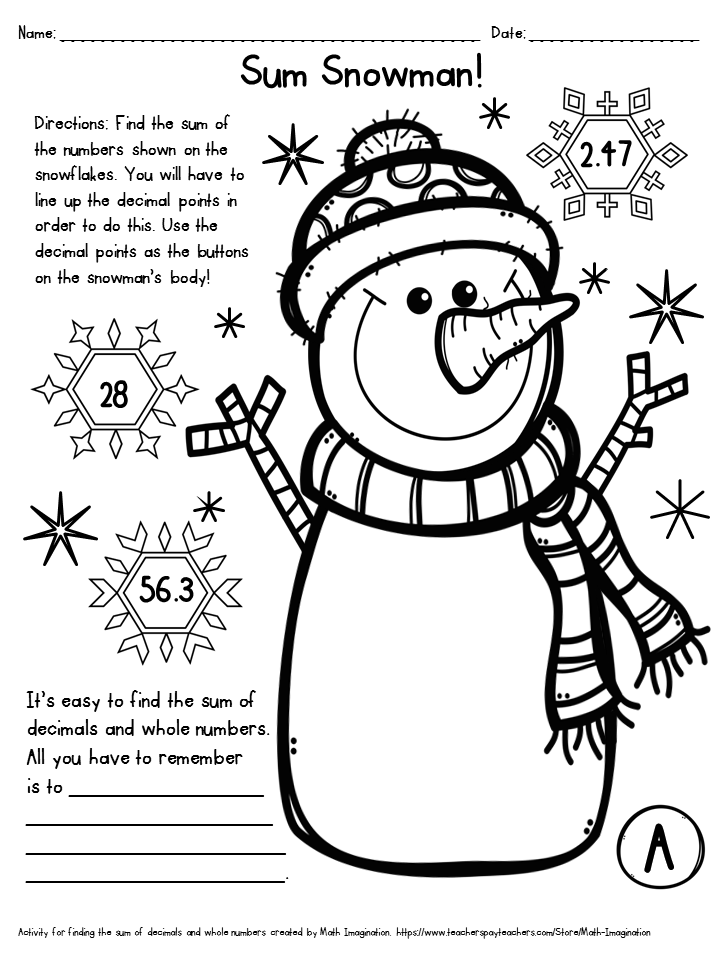


Everyone has a different problem, so no cheating could take place. I asked them to solve their problem on the back of their page first so if they had to erase, it was okay. Notice the snowball at the lower right hand corner? That's their problem's letter. After they solve their problem, they were to go to the board to check their answer. They just had to look for their problem's letter to do that.


I also displayed a picture of the snowman with a problem completed to show students how the "buttons" should look.  If they answered correctly, they were to complete the front of the page and color the snowman. If they were incorrect, they were to go back and correct it.


Students did enjoy the activity and there were many great discussions.  With this activity, I know a great memory was made that will help them remember to line up those decimals! Their discussions also helped them to complete the statement at the bottom of the page. It also makes a great display. It's a win-win!!!

You can find this activity HERE.

I hope you find this activity helpful. It can be used for different grade levels, as a ticket out the door or as I review.  

Thanks for reading and have a wonderful day!!!!


Thursday, June 23, 2016

Foam Counting Blocks Are For More Than Just Counting!

I found these at my local Dollar Tree, but I'm sure you can find similar ones else where.  I have also seen wooden counting blocks, but I prefer these for my stations since they are quieter.


When you first take them out of the package, they are sort of stuck to each other.
But they are really easy to pull apart.

Here is one option.  Create your own foam dice!

I first tap marker where I want my dots to go on the cube.

I then make the dots larger.  This helps me keep them lined up.

So there you have it! A pair of foam dice.  I used actual dice to determine the placement of the dots. Here is how they are set up, in case you don't have access to any.
1 is across from 6, 2 is across from 5, and 3 is across from 4.
These would be great to use with the Game Board I created HERE.


You don't have to use these only for dice.
There are a variety of uses.


Make fraction dice.
You can have students roll the dice and then add, subtract, multiply or divide them.

Make percent dice.
Have students roll dice, convert percent to decimals, then have them add or subtract them.


Make decimal dice.
Have students roll dice, then add, subtract, multiply or divide.

Here's a good one!  Give students two percent dice, two decimal dice and two fraction dice.  Have them roll and then place them in order from least to greatest!

Bright, colorful, inexpensive and so easy to make!

Here are a few tips when making your own foam dice:
  • Use a fine tip permanent marker. Thicker markers tend to bleed on the foam.
  • Wait a few seconds for ink to dry so that there are no smudges on your cube.
  • Write down numbers you would like to use on paper before creating your dice so that there are no repeats.
Thanks for looking!  Hope this was helpful!!


Tuesday, April 26, 2016

Jenga Math Review

A while back I posted about a used Jenga game I purchased at a Goodwill store.  Well, I finally finished it!  It took me a while because I didn't really know what to use it for or how to fix it up.


Well, I'm finally done and here is the final product!
I used an old plastic bin I had for
storage since the original
box wasn't in good condition. 
They all fit perfectly!

I used fine point permanent markers to make the game colorful.  I included various types of skills that my students need review on. Since the game blocks were in excellent condition and very smooth, it was easy to write on them with markers. 

TIP:  Use brand new fine tip markers.  For some reason, my used markers bled into the wood. 

One of my student groups already tried it out and they said it was "cool"! 

I hope these tips were helpful.  Let me know what you think!
:

UPDATE:  I was able to get a picture of Math Jenga in action.


I have my students seated in groups of four and I rotate stations around the room by groups.  Many students were anxious to get their turn at this station.  :D


Here is another great test review activity available at my Teachers Pay Teachers Store.