Showing posts with label adding. Show all posts

Sunday, January 22, 2017

Line them up!

I teach six 45 minute 7th grade math classes and one 45 minute math enrichment class. The math enrichment class rotates with three other core subject area teachers in my pod throughout the week. During enrichment, I try to focus on students' math weaknesses and create or look for activities to strengthen them. With that said, there is one weakness that was really driving me nuts! So this is what I did.

Many of my students were making careless mistakes when adding or subtracting whole numbers and decimals. They know about place value. They know how to set up a whole number as a decimal. However, I think they get "caught up in the moment" when solving a problem and just rush through it.  I don't know if you are aware of this, but, some students just don't like math and their goal is usually to hurry up and finish their work so that they can do something else. (Insert sarcasm here.)

I've tried several strategies, such as having them write whole numbers as money. Everyone likes money, right?! Well, that only helped a few. Then I tried having them underline the ones place in the numbers and to line those up. That was a flop. Apparently, it's too much work to underline numbers. When I would point it out to students, their response was, "Oh! I forgot." Now, when I say "point it out", all I had to say was, "This is set up incorrectly." and almost immediately they remembered the proper way.  So this is why I say that they are just rushing and they really do know how to do this. Don't you hate that this sort of stuff happens a lot in math class?

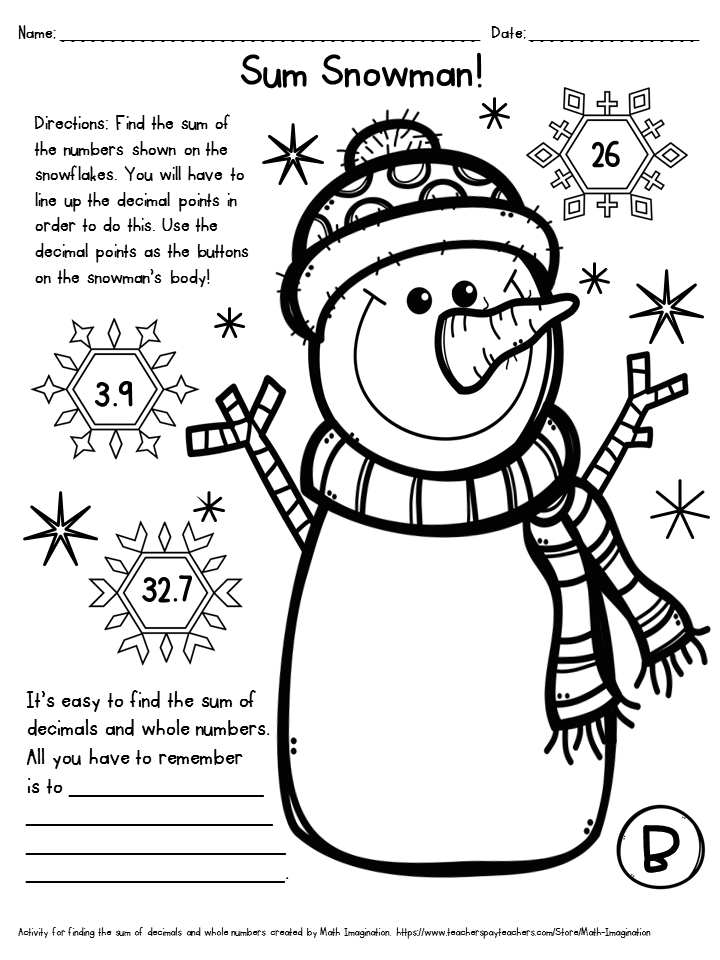
When I taught fifth grade back in the day, I remember a snowman activity I created that would help students focus on the correct way to set up problems when adding whole numbers with decimals. I gave students a picture of a snowman and a problem. They were to add three numbers, two decimal numbers and one whole number. They were to set up the numbers on the body of the snowman so that the decimal points were the buttons on the snowman. It was only one problem, but my goal with this activity was about quality, not quantity. It really helped that time, so why not try it out with my 7th graders during enrichment?

This is the activity as I created it for my 7th graders.


I made 26 different problems involving addition of two decimal numbers and a whole number. Students were each given a problem but asked to work in groups so that they could discuss and help each other when solving. 
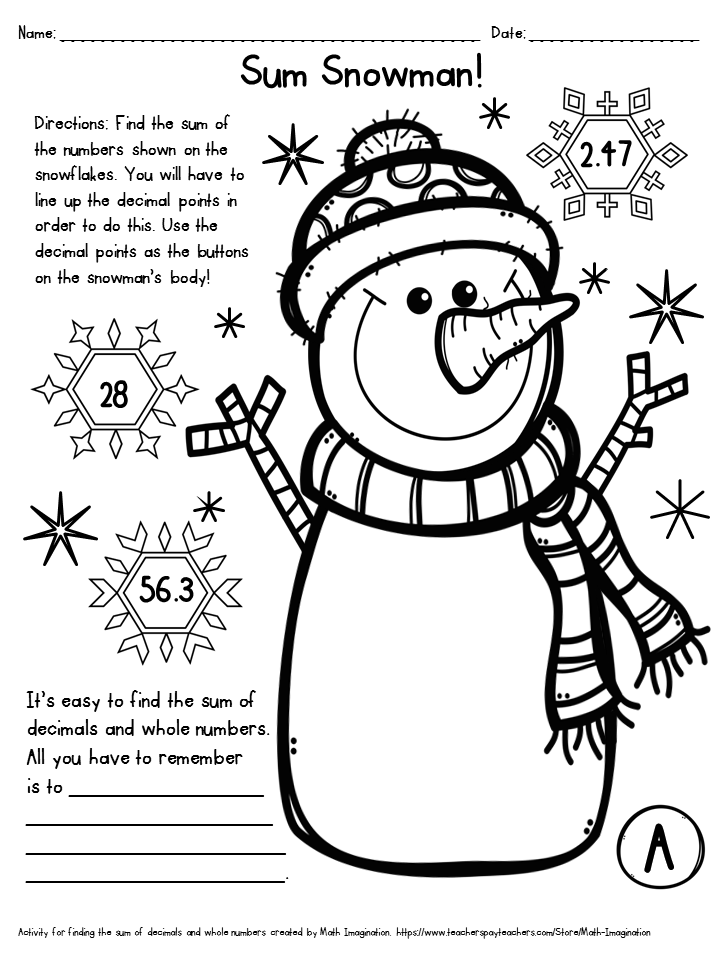


Everyone has a different problem, so no cheating could take place. I asked them to solve their problem on the back of their page first so if they had to erase, it was okay. Notice the snowball at the lower right hand corner? That's their problem's letter. After they solve their problem, they were to go to the board to check their answer. They just had to look for their problem's letter to do that.


I also displayed a picture of the snowman with a problem completed to show students how the "buttons" should look.  If they answered correctly, they were to complete the front of the page and color the snowman. If they were incorrect, they were to go back and correct it.


Students did enjoy the activity and there were many great discussions.  With this activity, I know a great memory was made that will help them remember to line up those decimals! Their discussions also helped them to complete the statement at the bottom of the page. It also makes a great display. It's a win-win!!!

You can find this activity HERE.

I hope you find this activity helpful. It can be used for different grade levels, as a ticket out the door or as I review.  

Thanks for reading and have a wonderful day!!!!


Wednesday, June 22, 2016

Practice Integers with a Deck of Cards!

First of all, I know first hand that buying materials for your classroom can get pricey and adds up to quite a bit by the end of the year.  This is why I try to look for ways to save money on items for my classroom.  I also try to look for items I can use in more than one way.

Now, onward to using a deck of cards for integers!

I found the best deal at Dollar Tree!  You get TWO decks of cards for $1!  Fifty cents a deck is a real bargain. Of course, if you can get them donated, that would be even better.


Here is what the package looks like if you happen to have a Dollar Tree near you.  If not, I'm sure you can find them at other types of dollar stores.


They are glossy and pretty durable.
I usually take out the Jokers, since I have no use for them.


This is how I use a deck of cards to have my students practice addition of integers.  My students call it Integer War and it is a game for two players.

First, I tell students that all face cards (King, Queen, Jack) have a value of 10.  All blacks are positive and all reds are negative.

For example, 6 of diamonds (red) has a value of (-6) and a Jack of spades (black) has a value of (+10).  I then instruct students to use addition to solve.

Step 1: Divide the entire deck of cards between two players.


Step 2: Both players take a card from the very top of their stack and place them down next to each other.  Be sure to tell you students that peeking is not allowed!  They MUST take the card from the top of the stack.  Now they have created an integer problem!  This one shows (+10) + (-8).
Step 3: The first student to shout out the answer takes both cards.  The coolest part is that they can use the symbols on the cards to create their "zero pairs" if they are still struggling solving it mentally!  Since face cards don't have symbols, you can have students take all face cards out for the first few times they play this game.  Then have them play the game with the face cards included as they are gradually building integer fluency.

Here are some more examples:

(+10) + (+7) = (+17)

(+10) + (-10) = 0


(-4) + (+10) = (+6)
(-10) + (+8) = (-2)
(-10) + (-10) = (-20)

It's that easy!

I think the colors really help students determine positive and negative values and understand when they have to add or subtract the values.


I usually have my students seated in groups of four. So what I do is have two students play against each other and the other two students use a calculator to check the answer.  That way they know who stated the correct answer first.  Then the pairs of students trade tasks.  It's a great way to build integer fluency and students end up discussing when answers are incorrect.  They teach each other!  How awesome it that?!

Take it to the next level!  After students understand directions and the goal of this game, change it up and have them subtract the integers.  I usually have them write down the problem when they use subtraction.  Eventually, I also have them practice multiplication of integers.

So you actually get THREE activities that will have your students practicing with integers using only one deck of cards!


WARNING!  When students are playing this game, you will hear them gradually get louder as they shout out the answer, because they want to win!  They get really excited.  Student engagement at it's finest!  :D

Here are some of the activities I have available at my Teachers Pay Teachers Store.

Integer Fluency Circles


Exponents with Integers


Christmas Tree Negatives and Positives - Mixed Computation with Integers This one is FREE!


I will be posting other ways I use decks of cards in my classroom at a later date.  Stay tuned!

Thanks for looking.  I hope this was helpful!